
Looking for great talent? Competencies may be your best ally
The primary mission of HR professionals focuses on four distinct objectives: Finding great talent Minimizing the learning curve to productivity ratio Maximizing employee engagement Reducing voluntary turnover (employee retention) These [...]
Build Models With Input From Job-Holders
SECONDARY DATA COLLECTION METHODS Observation of Job Holders Observation of job holders can be helpful in developing competency models, if a limited duration of observation will permit observing highly effective [...]

Using Competencies To Enhance Employee Performance
In the late '90s, the American Compensation Association (now WorldAtWork) sponsored a research study titled “Raising the Bar – Using Competencies to Enhance Employee Performance”. The results were published in [...]
Secondary Data Collection Methods
STEP 3 - DATA COLLECTION In addition to the primary data collection methods that were described in the previous sections, there are several other data collection methods that may be useful [...]
Conducting Behavioral Event Interviews
STEP 3 - DATA COLLECTION A Behavioral Event Interview is a 1 to 1½ hour interview, in which the interviewee is asked to provide highly detailed accounts of how he/she [...]
Using Resource / Expert Panels to Build Competency Models
A Component of Step 3 of Workitect's Model-Building Process. A Resource Panel is a three to six-hour facilitated meeting with an agenda that is similar to, but broader than, the one [...]
Conducting Job Analysis Interviews
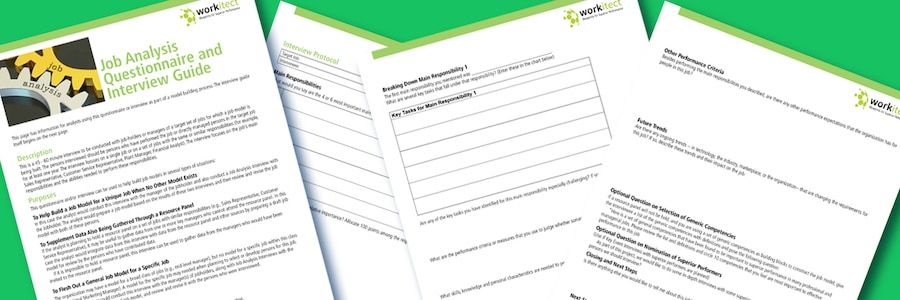
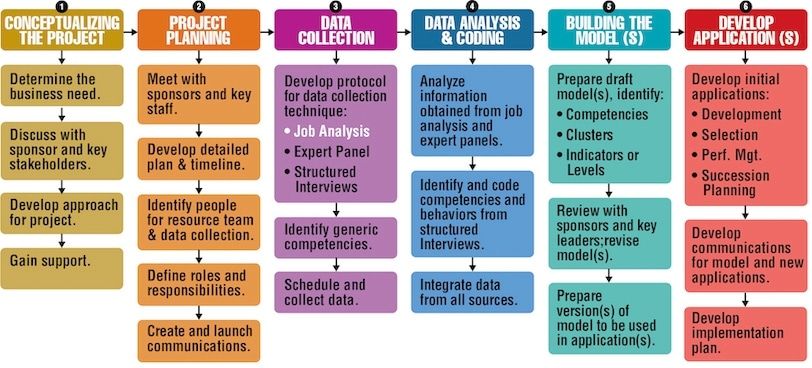
JOB ANALYSIS is a key component of Workitect's competency-modeling process and is completed at the beginning Step 3 - DATA COLLECTION. Job Analysis Interviews are usually conducted with capable [...]
Identifying a Set of Generic Competencies
Why should you use a dictionary of generic competencies when you can develop your own dictionary? Because so much competency modeling has been done over the past 40 years, it [...]