
It is difficult to develop all competencies through formal training. Some competencies are not acquired through specific training. Instead, the person is thrust into a situation where it is important to succeed and where success depends on certain skills and behaviors. In this kind of situation, the person may try to imitate available role models, and may also try out various new behaviors. If the behaviors are successful, they become habits or skills.
In this natural acquisition process, not everyone succeeds. For those who do, success comes from a combination of situational pressure, willingness to try new behaviors, and specific aptitudes.
To supplement this natural acquisition process, there is another process by which we can develop competencies as part of a professional development program. This process has seven steps: (1) identification of the required competencies, (2) self-assessment, (3) observation and study, (4) practice, (5) feedback, (6) goal-setting, and (7) on-the-job support.
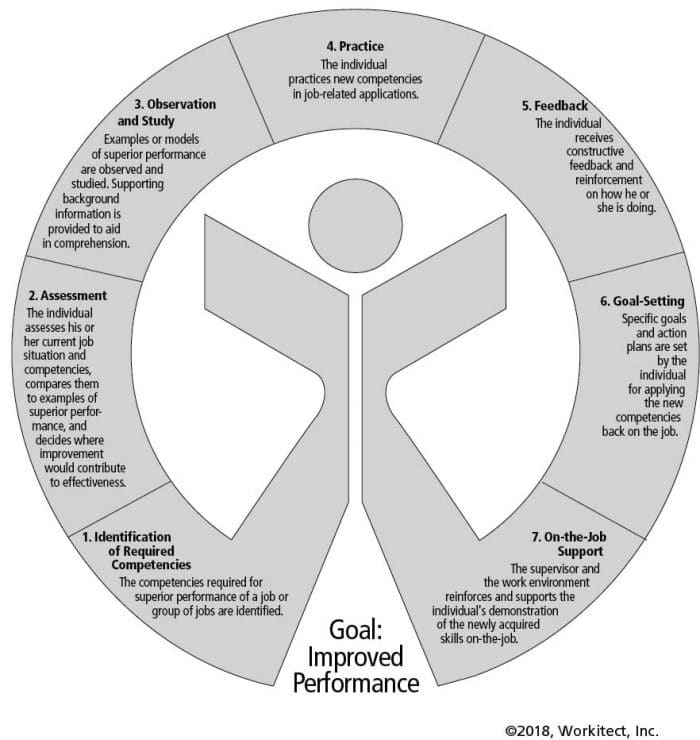
IDENTIFICATION AND UNDERSTANDING OF REQUIRED COMPETENCIES means that a either through a job competency model or another means, you are able to understand each competency well enough to recognize it in others’ behavior. Studying the behavioral indicators listed under each competency will help you accomplish this step. You must also be able to apply the competency to yourself, to know when you have demonstrated the competency, and when you had the opportunity to apply the competency but did not do so. To develop your understanding of a competency, think about how you can use the competency and its behaviors in your work. In which specific situations did you use the competency, and in which situations did you miss an opportunity to use it?
SELF-ASSESSMENT means generating an accurate perception of how often and how well you demonstrate the competency. This is often a difficult step, because many people
over-estimate their strengths. Research has shown that two-thirds of all employees see
themselves in the top third, in terms of overall performance. To assess yourself accurately, you need honest feedback from others who can observe how you work. (Tips on how to do this are provided throughout the remainder of this book.)
OBSERVATION AND STUDY, accompanied by the other six steps, will help most people develop a competency. The way in which you learn, i.e. your “learning style”, will determine whether you will more effectively develop a competency by studying the
competency and observing other people modeling it , and then practicing it. Many people will rely on the next step.
PRACTICE means trying out new behaviors and skills in a relatively “safe” environment, such as a training course or an activity outside work, where you can make mistakes and try to develop your skill.
FEEDBACK means receiving constructive information that conveys the extent to which your “new” behavior is observed and is effective. The feedback from others that contributes to the accurate Self-Assessment step is also important to knowing whether the development or strengthening of a competency is occurring. If you don’t know how you are doing, you won’t be able to modify your behavior to ensure that the competency is learned.
GOAL-SETTING means that you have established a specific goal and timetable to acquire a competency. The importance of goal-setting is described later in this chapter.
SUPPORT AND REINFORCEMENT means that when you demonstrate the competency back on the job, you are made aware that “it matters”. This support and reinforcement can be formal or informal, subtle or not subtle, immediate or long-term. It can be a pat on the back or satisfying appraisal discussion. It is another form of feedback and is essential to maintaining the new behaviors of a competency.
Read more in Workitect’s Competency Development Guide.
 To learn more about our products and services, and how competencies and competency models can help your organization, call 800-870-9490, email edward.cripe@workitect.com
or use the contact form at Workitect.
©️2019, Workitect, Inc.

Leave A Comment