Difference Between Job Descriptions and Competency Models
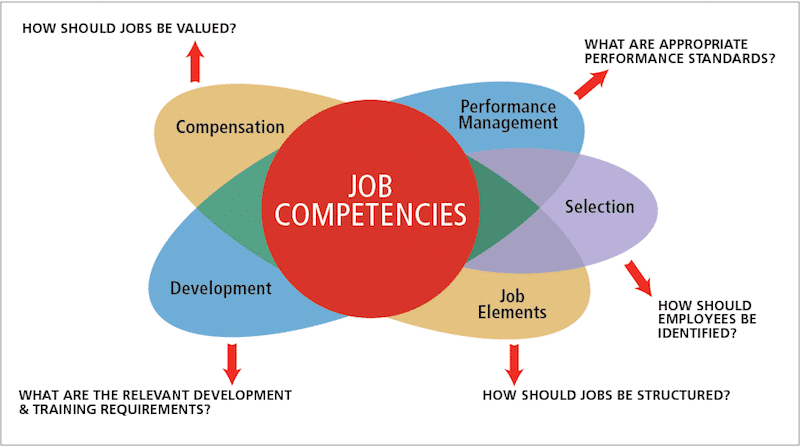
Job descriptions are often equated with job competency models. While similar in content, there are important differences. They serve different purposes and are developed in different ways. Here is a comparison of the two documents.
Job Descriptions
• Title of position
• Department
• Reports to (to whom the person directly reports)
• Overall responsibility
• Key areas of responsibility
• Qualifications (skills and experience required)
Applicatons: recruitment, compensation structure, performance management (establishing job standards and goals), training.
Example: Project Manager
Job Competency Models (Workitect method)
• Title of Position
• Major responsibilities
• Performance criteria for each responsibility
• Qualifications (competencies: skills, knowledge, and underlying characteristics* required)
• Behavioral indicators (specific ways of demonstrating the competency)
• Links between main responsibilities and competencies
Applications: talent management, succession planning, performance management (evaluating characteristics used to meet or not meet job goals), assessment and selection, training and development.
Examples: Project Manager, Executive, Account Rep, Call Center Manager, Human Resources Profesional
*A job competency is an underlying characteristic of a person that results in effective and/or superior performance in a job. The characteristic may be a motive, trait, skill, self-image, or body of knowledge. The Competent Manager, Boyatkis, 1982
Some organizations have combined the two documents and have added required competencies to job descriptions. The advantages are that it reduces the number of HR forms that are needed and makes the list of required qualifications more complete. The main disadvantage is that data needed for talent management, development, and succession planning is usually incomplete.
Regardless of where the competencies are listed, the most important determinant of their effectiveness is how they were identified. A description of the process creating competency models can be found on pages 5 & 6 of Integrating HR & Talent Management Processes.
FAQ
Can a generic off-the-shelf competency model be used? Don’t jobs with the same title require pretty much the same competencies in all organizations?
Each organization has its own culture and “way of doing business”. Even for jobs with identical titles, job success in one organization will require some competencies that are different in another organization. Even a small difference could be critical. This is why we only build custom models, or teach internal consultants how to build their own models.

To learn more about our products and services, and how competencies and competency models can help your organization, call 800-870-9490, email info@workitect.com
or use the contact form at Workitect.
©️2019, Workitect, Inc.

Tags: competencies, competency, HR, job competencies, job description, modeling, models, project manager
Related Posts
Recent Posts

In Good Times & Tough Times, You Need Competent People
People. Not money, not buildings, not tools. Competent people are your most valuable resource. And…

What is the One-Size-Fits-All Competency Model?
In the One-Size-Fits-All Approach, a competency model is developed for a broadly defined set of…
Is Your Performance Management System Working?
If it isn’t working, consider a… COMPETENCY-BASED PERFORMANCE MANAGEMENT SYSTEM Many organizations are becoming…

The New Reality: Career Streams vs. Career Ladders
Along with many other changes in how employee performance is managed, there is a…