
Conducting Job Analysis Interviews
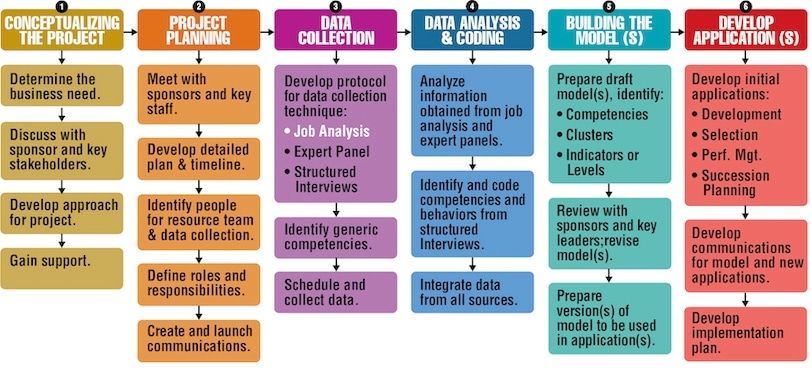
JOB ANALYSIS is a key component of Workitect’s competency-modeling process and is completed at the beginning Step 3 – DATA COLLECTION.
Job Analysis Interviews are usually conducted with capable job incumbents, but they can also be conducted with managers of job incumbents. The interview starts with a question about the four or five most important main responsibilities in the job. When these have been identified, the interviewer focuses on each main responsibility and asks about: (a) key tasks for this responsibility, (b) skills and knowledge required to perform the tasks for this main responsibility, and (c) performance criteria or measures used to assess performance in the job. The interviewee may also be asked to review a list of generic competencies and their definitions and select the 10 most important competencies for the job.
Job analysis interviews are essential if the competency model will be presented as part of a broader job model that includes a breakdown of the main responsibilities and their related tasks. Job analysis interviews are also needed if the competency model will be used to develop training courses or programs for job incumbents. If you plan to facilitate a Resource Panel or conduct Structured Event Interviews, it is useful to have conducted at least a couple of Job Analysis Interviews, so that you have a concrete understanding of job. A final benefit of Job Analysis Interviews is that they provide most of the information needed to prepare a job description.
Implementing Job Analysis Interviews
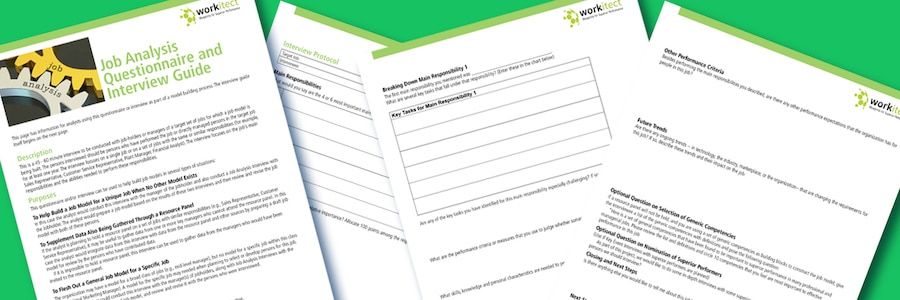
Plan to conduct three or four of these interviews, allowing about one hour per interview. The interviewees should be capable performers, but they do need to be superior performers. Begin the interview by explaining the purposes and scope of project and the format of the interview. Then use or adapt the Job Analysis Interview protocol provided in Quick-Start Competency-Modeling program or Building Competency Models workbook. Ask follow-up questions when this is necessary to clarify the interviewee’s responses. Take detailed notes on each interview but also tape record the interviews so that you will be able to listen to the tapes to clarify your notes later, if necessary. This Workitect Job Analysis Questionnaire and Interview Guide template can be used to conduct the interview and collect the necessary data >>
Analyzing Job Analysis Interviews
Interviewees will vary in the way they describe main responsibilities, tasks and skills. One way to analyze these interviews is to use the outline of the interview protocol to prepare a composite set responses that reflect common themes across interviewees. To identify competencies based on these interviews, you can (a) look to see which of the generic competencies were selected by two or more of the interviewees, and (b) draw logical inferences about which generic competencies are required, based on the tasks and skills needed to perform each main responsibility. For example, if people management is a main responsibility, it is likely that the competency model will need to include one or more of the generic competencies related to people management, such as Performance Management, Empowering Others, and Developing Others.
Conducting job analysis interviews is taught in Workitect’s Building Competency Models workshop.
 To learn more about our products and services, and how competencies and competency models can help your organization, call 800-870-9490, email info@workitect.com
or use the contact form at Workitect.
©️2022, Workitect, Inc.


Tags: building, competencies, competency, description, interviewing, job, leadership assessment development, models, performance, position, productivity, talent
Related Posts
Recent Posts

In Good Times & Tough Times, You Need Competent People
People. Not money, not buildings, not tools. Competent people are your most valuable resource. And…

What is the One-Size-Fits-All Competency Model?
In the One-Size-Fits-All Approach, a competency model is developed for a broadly defined set of…
Is Your Performance Management System Working?
If it isn’t working, consider a… COMPETENCY-BASED PERFORMANCE MANAGEMENT SYSTEM Many organizations are becoming…

The New Reality: Career Streams vs. Career Ladders
Along with many other changes in how employee performance is managed, there is a…